RMS Titanic · nautical.im
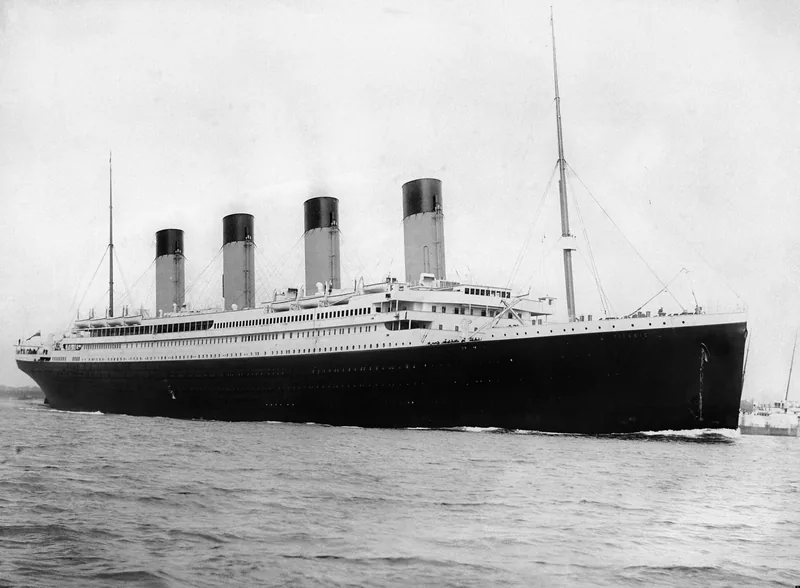
A White Star liner, 1912
Titanic
At 11.40 p.m. on 14 April 1912, in the wording of the British inquiry, Titanic struck an iceberg, and at 2.20 a.m. the next day she foundered.1 In all, the inquiry says, 2,201 persons were on board when Titanic left Queenstown: 1,316 passengers and 885 crew.1 The inquiry’s table of numbers saved gives a total of 711 people saved out of 2,201, or 32.30 per cent.1
The night of 14–15 April 1912
An hour-by-hour log, in ship’s time
Ship’s time, 14–15 April 1912
11:40 p.m., 14 April
The log starts at the collision. Use Play or the step buttons, or just read the timetable below.
This is a sourced chronology, not a game, and it has no score. If you prefer less motion, the timetable stays put and Play jumps to the last entry.
| Ship’s time | What the official record says |
|---|---|
| 11:40 p.m., 14 April | At 11.40 p.m. on 14 April 1912, in the wording of the British inquiry, Titanic struck an iceberg, and at 2.20 a.m. the next day she foundered.1 The inquiry’s later times all come with a warning that witness clocks, after the collision, are unreliable. |
| 12:15 a.m. | At 12.15 a.m., the inquiry says, the distress signal CQD was sent, and was heard by several steamships and by Cape Race.1 Royal Museums Greenwich instead times the first wireless call at 00.45; that disagreement is kept in view. |
| About 12:45 a.m. | At about 12.45 First Officer Murdoch gave the order to lower No. 7 boat, on the starboard side, to the water. The inquiry’s own table of leaving times puts No. 7 at 12.46 a.m., and it immediately warns that all times after the collision, as given by witnesses, are unreliable.1 Boxhall began firing distress rockets at about the same time. |
| 2:20 a.m., 15 April | Greenwich, like the inquiry and Britannica, dates the foundering to 02.20, and the first lifeboat picked up by Carpathia to 04.10.2 The inquiry and Britannica use the same 2.20 a.m. moment. |
| 4:10 a.m. | At 4 o’clock Rostron considered he was practically up to the position given; he stopped at 4.05 and picked up the first boat, No. 2, at 4.10. It was 8 a.m. before all the boats had been picked up.1 It was 8 a.m. before all the boats had been picked up. |
Ship’s time, 14–15 April 1912, from the British inquiry, with Greenwich kept in view where the clocks differ. The table stays on the page so the log can be read without JavaScript.
The British inquiry warns that all times after the collision, as given by witnesses, are unreliable. We still give the court’s own timetable, because it is the official record, and we keep that warning in view.
Three tickets
First, second and third class, as the inquiry counted them
Of those passengers, the inquiry lists 325 in first class, 285 in second class and 706 in third class, including 109 children.1 On that same table, 203 of 325 first-class passengers were saved (62.46 per cent), 118 of 285 in second class (41.40 per cent), and 178 of 706 in third class (25.21 per cent). Of the crew, 212 of 885 were saved.1
White Star ticket
First class
325 passengers · 203 saved — 62.46 per cent
The inquiry lists 180 men and 145 women in first class, including 6 children. Almost all of the women and both groups of first-class children were saved; 57 of 175 adult men were saved. Britannica also gives first class the highest survival rate, at about 62 per cent. Greenwich notes first-class attractions including squash courts, a Turkish bath, a gymnasium and the first swimming pool on a ship.
White Star ticket
Second class
285 passengers · 118 saved — 41.40 per cent
The inquiry lists 179 men and 106 women, including 24 children. All 24 second-class children were saved, and 80 of 93 adult women; only 14 of 168 adult men were saved, the lowest men’s rate of the three classes on the official table.
White Star ticket
Third class
706 passengers · 178 saved — 25.21 per cent
The inquiry lists 510 men and 196 women, including 79 children — more than half of everyone on the passenger list. 178 were saved, or 25.21 per cent, a figure Britannica also rounds to about 25 per cent. About 410 of the third-class passengers, the inquiry notes, were foreigners.
The boats
Room for 1,178, and 2,201 people on board
Titanic was provided with 20 boats, the inquiry says, with total accommodation for 1,178 persons: fourteen lifeboats designed to carry 65 people each, two emergency cutters for 40 each, and four Engelhardt collapsible boats for 47 each.1 Royal Museums Greenwich says she was equipped with 20 lifeboats, designed to hold around 1,178 people, and that her own capacity was 3,320 people.2
Ship’s notice
The twenty boats
Capacity is from the Board of Trade figures in the British inquiry and is solid. The “left in boat” column and the leaving times are from the same report’s testimony table, which the court itself called “quite unreliable.”
| Boat | Side | Type | Capacity | Left in boat* | Left at* |
|---|---|---|---|---|---|
| 7 | Starboard | Lifeboat | 65 | 27 | 12.46 a.m. |
| 5 | Starboard | Lifeboat | 65 | 41 | 12.55 a.m. |
| 3 | Starboard | Lifeboat | 65 | 50 | 1.00 a.m. |
| 1 | Starboard | Emergency cutter | 40 | 12 | 1.10 a.m. |
| 9 | Starboard | Lifeboat | 65 | 56 | 1.20 a.m. |
| 11 | Starboard | Lifeboat | 65 | 70 | 1.25 a.m. |
* Testimony figures, not a reliable head-count.
Belfast, 1909–1912
Built side by side with Olympic
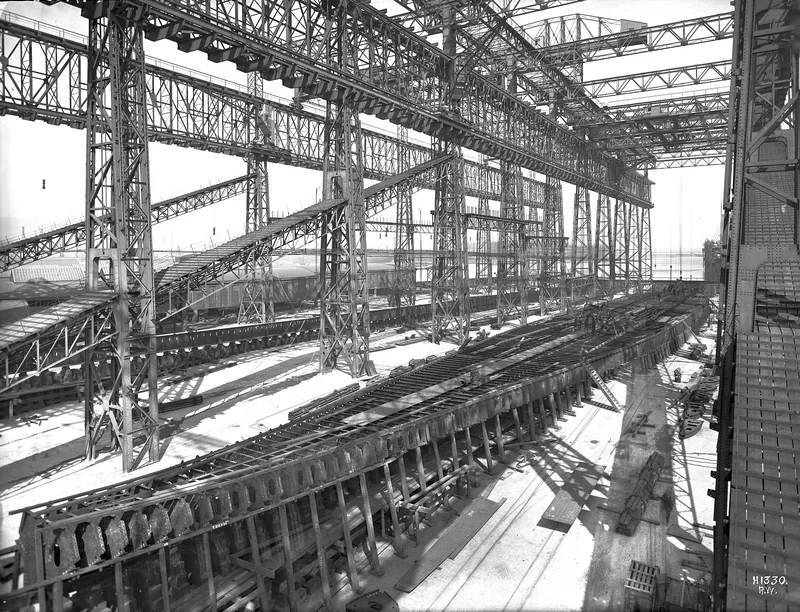
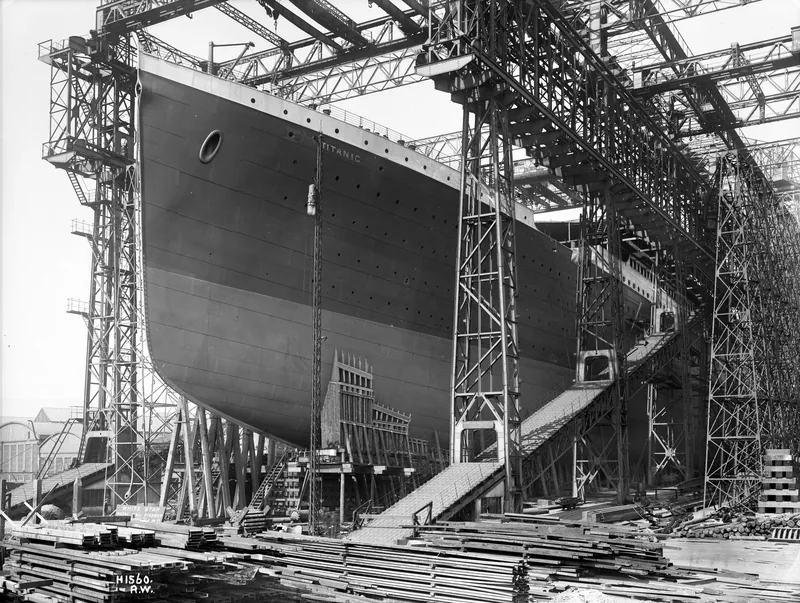
On 31 March 1909, some three months after work began on Olympic, the keel was laid for Titanic. The two ships were built side by side, Britannica says, largely designed by Thomas Andrews of Harland and Wolff.3 Titanic was launched on 31 May 1911, then fitted out. In early April 1912 she underwent sea trials and was declared seaworthy.3
Explore
More of her story
The night
An hour-by-hour log of 14–15 April 1912, in ship’s time.
The lifeboat board
Twenty boats, official capacity, and the figures the court itself distrusted.
Three tickets
First, second and third class, as the inquiry counted them.
The ship
Built in Belfast: dimensions, bulkheads, and the “practically unsinkable” wording.
The maiden voyage
Southampton, Cherbourg, Queenstown, and the ice warnings.
What the court found
Excessive speed, the rockets, and the Californian.
The wreck
Found in 1985, in two pieces, 12,500 feet down.
The official numbers
2,201 on board, 711 saved, and why other good sources round those figures.
Shop & support
Printable kits and books
A flagship reference guide, a short activity pack and a companion to the night of 14–15 April, all held for now. No pop-ups. No intrusive advertising. Just interesting stuff.
The Titanic Reference Guide
A fact-checked 11-page guide to RMS Titanic: how she was built, the official numbers, the night of 14–15 April 1912, and what the 1912 inquiry found. A4 and US Letter.
The Titanic Activity Pack
A 6-page respectful inquiry quiz, a lifeboat-board worksheet and a class-survival table, following the sourced wording used on titanic.nautical.im. A4 and US Letter.
The Night of 14–15 April 1912
A 6-page sourced companion to the hour-by-hour log, the distress messages, Carpathia’s rescue, and what the 1912 inquiry recorded about that night. A4 and US Letter.
The Complete Titanic Printables Bundle
All three packs (23 pages), A4 and US Letter, at a bundle price. Credited public-domain photographs and labelled tables, not figurative drawings.
Books and guides
Affiliate links to Amazon UK searches, not endorsements of particular titles. As an Amazon Associate I earn from qualifying purchases.
- The 1912 British inquiry (affiliate link) Lord Mersey’s official report, if you want the wording we quote.
- Titanic history books (affiliate link) General histories of the ship and the maiden voyage.
- Titanic Belfast guides (affiliate link) If you are planning a visit to the yard where she was built.
- White Star Line books (affiliate link) The company that owned Olympic, Titanic and Britannic.