Harland & Wolff, Belfast
The ship
A White Star liner designed for comfort rather than speed, built beside her sister Olympic, and fitted with sixteen compartments that were widely believed to make her unsinkable.
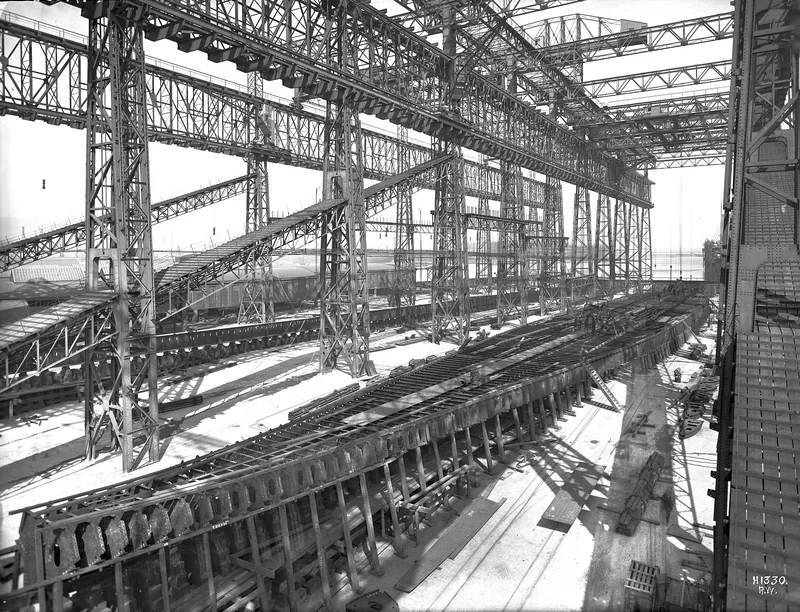
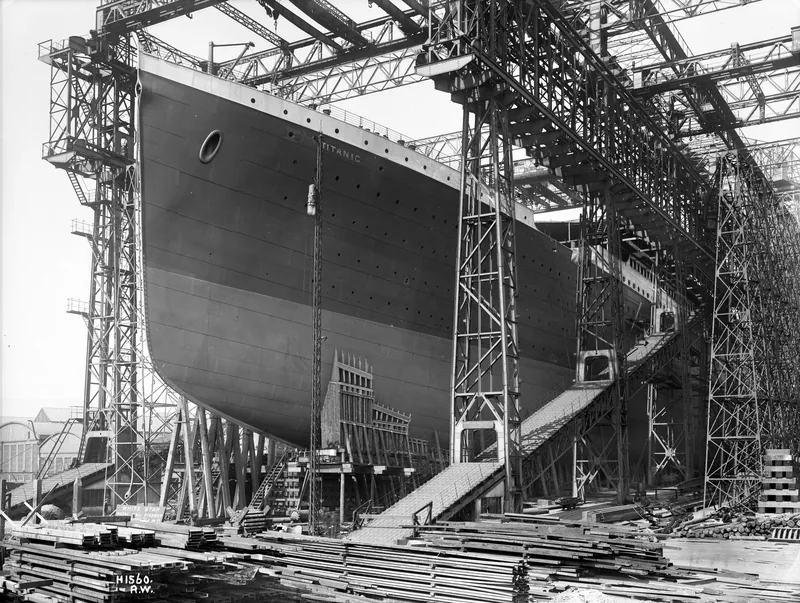
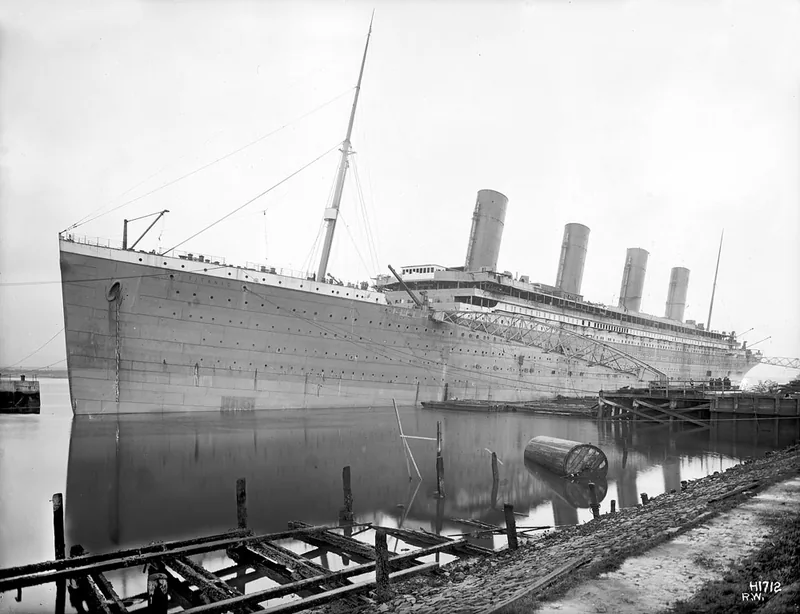
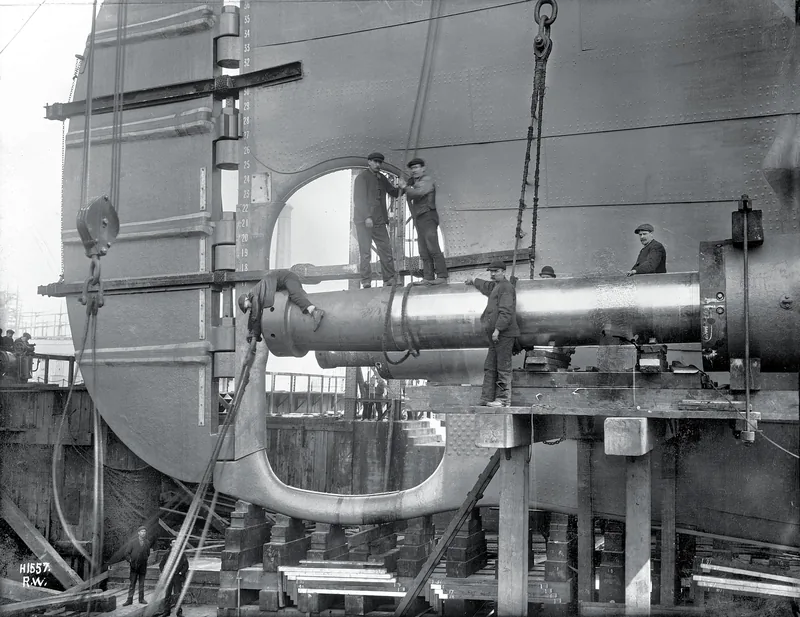
White Star, Britannica says, planned a class of large liners known for comfort instead of speed: Olympic, Titanic and Britannic, built by Harland and Wolff in Belfast.1 On 31 March 1909, some three months after work began on Olympic, the keel was laid for Titanic. The two ships were built side by side, Britannica says, largely designed by Thomas Andrews of Harland and Wolff.1 Titanic was launched on 31 May 1911, then fitted out. In early April 1912 she underwent sea trials and was declared seaworthy.1
What the official papers say she measured
The inquiry describes Titanic as a three-screw vessel of 46,328 tons gross and 21,831 net register tons, built by Harland & Wolff for the White Star Line service between Southampton and New York, and registered at Liverpool, official number 131,428.2 Her registered dimensions, the inquiry says, were length 852.50 feet and breadth 92.50 feet. Displacement at 34 feet 7 inches is given as 52,310 tons.2 Encyclopaedia Britannica gives the length as approximately 882.5 feet (269 metres) and the beam as about 92.5 feet (28.2 metres), with a gross registered tonnage of 46,328 tons, and says that fully laden she displaced more than 52,000 tons.1 Greenwich gives registered dimensions of length 852.5 feet, length overall 882.75 feet, breadth 92.5 feet, depth 59.6 feet, and tonnage gross 46,329, net 21,831, with a service speed of 21 knots.3
The inquiry’s registered length is 852.50 feet; Royal Museums Greenwich gives that same registered length and an overall length of 882.75 feet; Britannica gives approximately 882.5 feet. These are not the same measurement, and all three stay in view.
The reason she is often called RMS Titanic, Greenwich says, is that RMS stands for Royal Mail Ship: she carried post.3 Greenwich names her two sister ships: RMS Olympic, launched in 1910 and scrapped in 1935, and HMHS Britannic, launched in 1914 and sunk by a mine on 21 November 1916.3
Sixteen compartments
Fifteen transverse watertight bulkheads divided the ship into 16 separate compartments.2 The builders claimed that four of the compartments could be flooded without endangering the liner’s buoyancy. “The system led many to claim that the Titanic was unsinkable.”1 Royal Museums Greenwich is plain that Titanic “was never actually described as ‘unsinkable’.” The claim made by the builders, it says, was that she was “practically unsinkable.”3
Royal Museums Greenwich says the builders’ wording was “practically unsinkable,” and that she was never actually described as simply unsinkable. Britannica records that the system led many to claim she was unsinkable. We keep both.
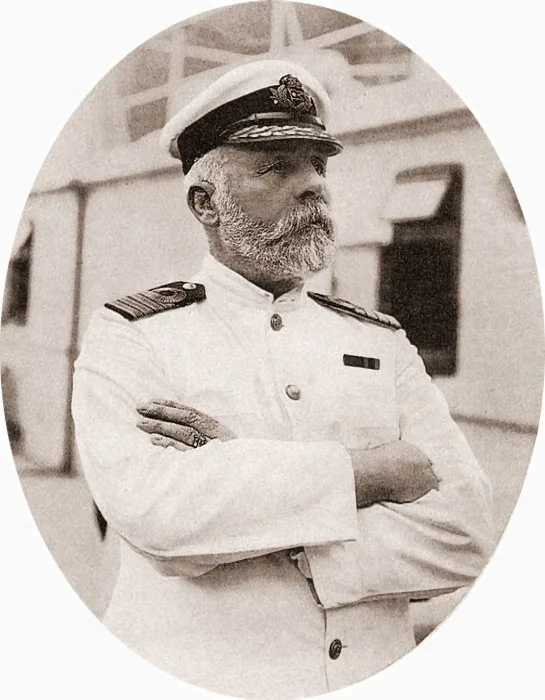
Captain Edward John Smith held an extra master’s certificate, the inquiry records. There is more about him, and about the court’s finding, on what the court found.